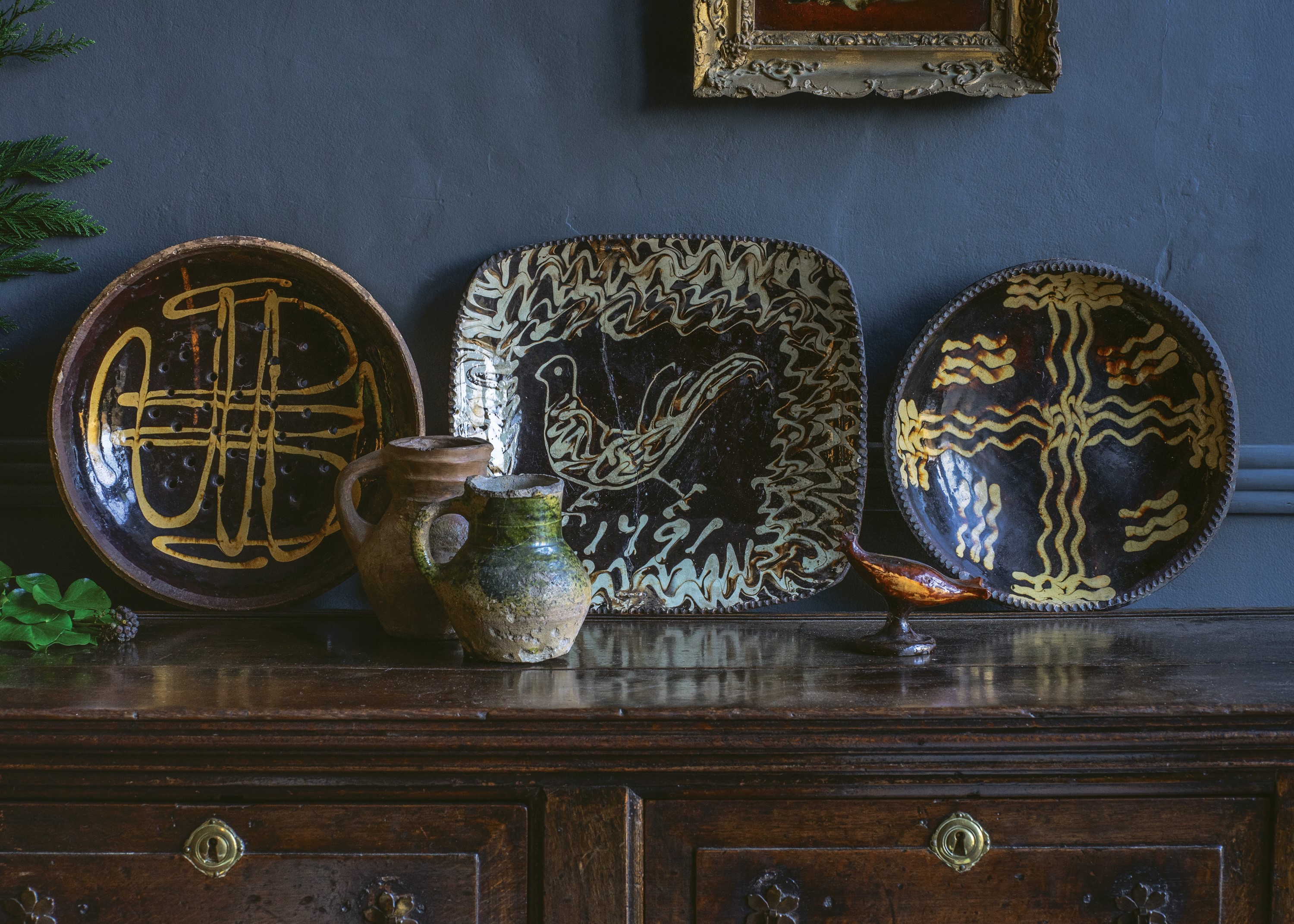
Bojewyan Pottery, based in Cornwall, was established by Pete Smith in 1974 and was the centre of Smith’s lifelong engagement with clay. For much of his career, Peter worked as a potter whose forms were grounded in function yet animated by a rigorous curiosity about materials. His approach was analytical but never academic; he understood clay, glaze, and firing as living systems rather than fixed recipes. This scientific sensitivity to material behaviour underpinned even his most seemingly “rustic” surfaces.
Smith’s early grounding owed much to the philosophy and practice of Bernard Leach, whose influence is evident in Smith’s respect for functional domestic ware and the seriousness with which he approached making. Smith’s practice evolved continually, and in later years his work became more abstract and expressive, allowing improvisation and intuition to play a greater role in form-making.
In the 1980s and 90s, Peter was also an influential teacher of ceramics at Falmouth University, where he encouraged a spontaneous and improvised approach based on developing technique and an understanding of the medium of clay as an expressive and practical form.
His openness led to his collaboration in the research of Debra Sloan during her Leach residency in 2017, and a publication exploring the West Country roof finial tradition:
‘Up on the Roof: Bernard Leach and the Equestrian Ridge Tile Tradition’.
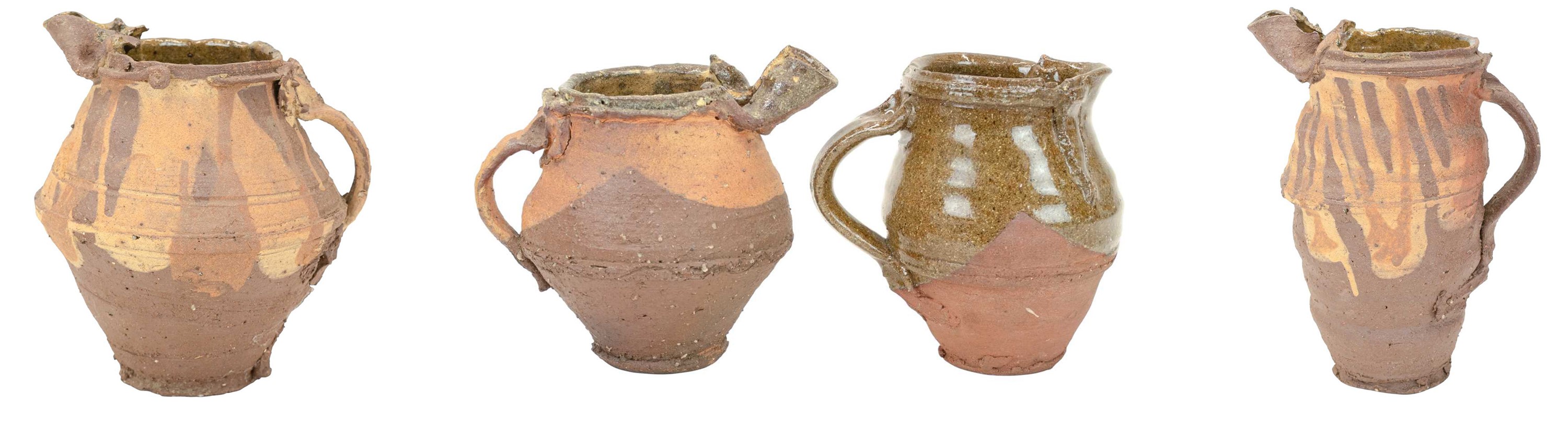
His own pieces in this collection in our January Antiques Sale display a balance between control and freedom. Smith’s pots often appear straightforward, bowls, dishes, jars, but on closer inspection, reveal subtle asymmetries, layered slips, and expressive marks. His surfaces are not decorative for their own sake; they record his process, response to his material, and decision-making. What might initially be read as “rough” or “simple” is, in fact, deeply considered.
In his later work, Smith increasingly combined wheel-thrown elements with hand-built forms, pushing domestic pottery towards the sculptural without abandoning function. Handles might feel deliberately weighted, rims intentionally irregular, and volumes slightly off-centre. These were not flaws but invitations, to touch, to use, and to notice. His pottery insists on engagement, asking the user to slow down and become part of the object’s ongoing life.
Smith’s personality was inseparable from his work. He spoke directly, analytically, and sincerely, was generous with his time, whether discussing glaze formulation or reflecting on the evolving legacy of Leach. This clarity of thought translated into a distinctive visual language: one that valued honesty of materials over surface polish.
Beyond the pottery studio, Smith was also a lifelong musician. A jazz drummer, he provided rhythmic foundations for traditional jazz bands and played for Acker Bilk, before later embracing the abstract expressionism of Ornette Coleman. That musical journey, from structure to improvisation, mirrors the trajectory of his ceramic practice. Rhythm, variation, and responsiveness run through his pots just as surely as they did through his music.
The pottery in this collection is therefore more than a group of objects; it is a record of a life spent thinking through making, and noticing. Functional yet expressive, grounded yet exploratory, Peter Smith’s pottery occupies a space where art and craft meet without hierarchy. Whether in daily use or simply on display, these works speak of clay, time, and of a maker who understood that the most meaningful objects are those that live fully in the world.
We personally mourn the loss of Pete Smith here in the saleroom at Lay’s. He was a quiet and gentle presence, hugely knowledgeable, and also unselfishly generous in sharing his knowledge. We fondly remember an occasion when his wise counsel steered us in the right direction some years ago whilst cataloguing a valuable Ewenny jug. Indeed, without the rather obscure publications he kindly loaned us for our research, we may not have correctly identified the piece. It went on to sell for the considerable sum of £6,000, in no small part thanks to Pete.
He shall be hugely missed, but we shall enjoy the wonderful work he left behind in these pieces.
With sincere thanks to Matthew Tyas of Leach Pottery for his warm-hearted commendation, and to David Williams, whose thoughtful obituary of Peter Smith in the Guardian greatly informed this blog post.
The news, history and stories behind our art and antiques