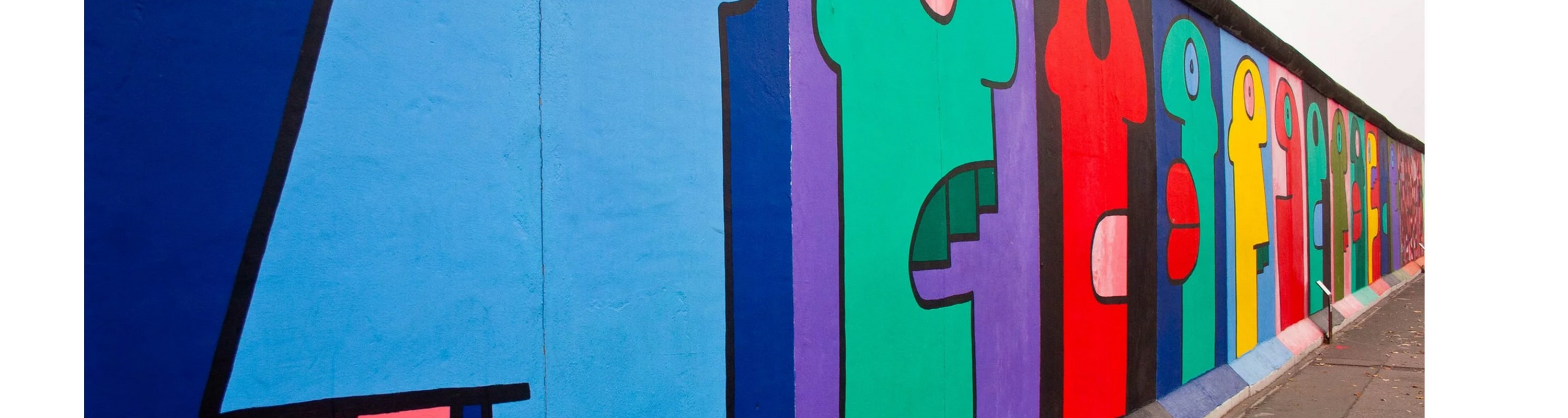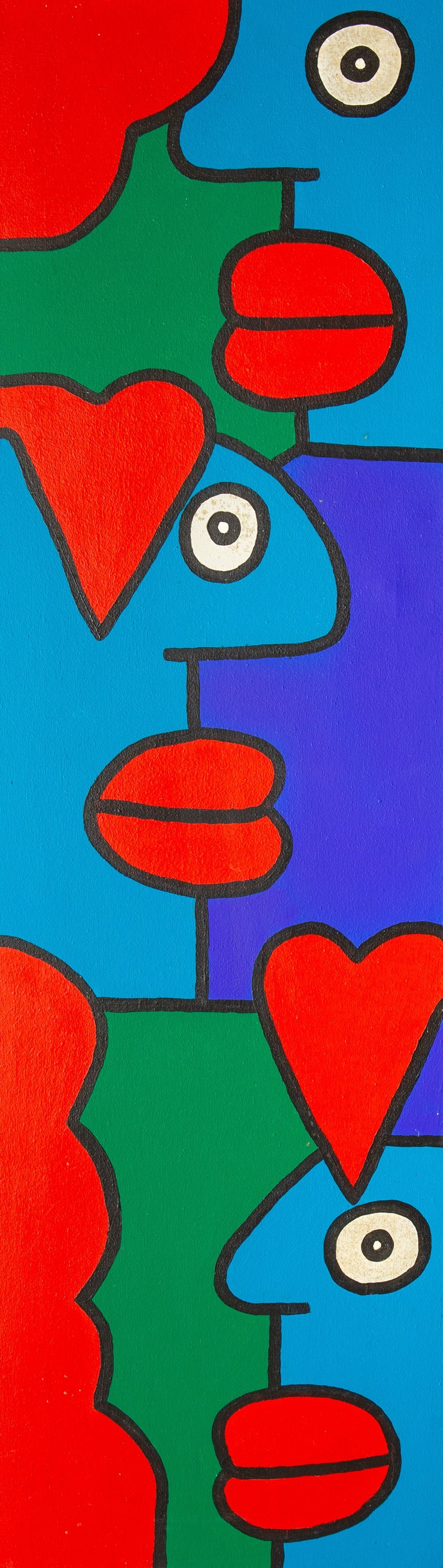
Lot 699
" Where else to find kilometres of painted concrete wall in Europe other than in West Berlin? I used to paint the Wall every day. All my ideas came to me not from the head to the hand but from the hand to the head. From the beginning, we used to collect leftover paint and materials from the renovation of houses in Kreuzberg. We made do with whatever we could find. We had no money to buy materials." Thierry Noir
The Berlin Wall
A few years after World War II, East Germany was constituted as a communist state controlled by the Soviet Union, while West Germany was formed out of the French, British and American occupation zones. The Berlin Wall encircled West Berlin from 1961 to 1989, separating it from East Berlin and the German Democratic Republic (East Germany). It was a complex multi-layered system of barriers patrolled by armed guards, had guard towers at intervals along its 3 metre concrete walls, and a wide area known as the ‘death strip’ that contained anti-vehicle trenches and other defences. Its purpose was to prevent East German citizens from escaping to the West. The wall became a physical symbol of the Cold War: a division not only of Europe geographically, but also the global ideological divide between communism and democracy.
West Berlin in the 1980s was a decadent, hedonistic enclave that artists and musicians flocked to. Raw, exciting and Avant Garde, the DIY music and art scene attracted Western musicians like Nick Cave, Iggy Pop and David Bowie, riding the Neue Deutsche Welle (the New German wave). The French artist Thierry Noir arrived in West Berlin in 1982. He lived in a squat on Mariannenplatz overlooking the Berlin Wall. The squat, The Georg von Rauch Haus had become an important centre for the city's left-wing, countercultural movement during the 1970s.
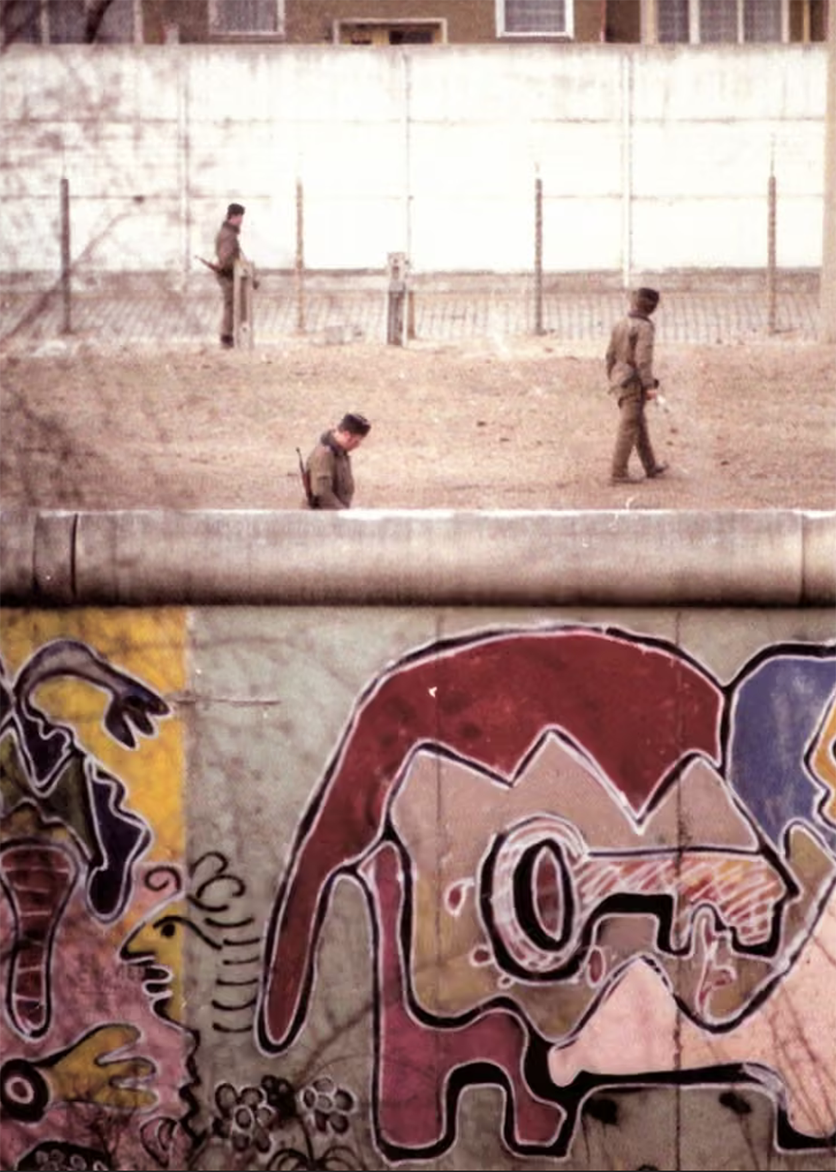
Photo by Noir taken from the squat where he lived of border police on the 'Death Strip' with some of his imagery on the Wall
In 1984, Noir began painting the Berlin Wall with fellow French artist, Christophe-Emmanuel Bouchet. Painting on the wall was absolutely forbidden; it was built 3 metres beyond the official border so the east-German soldiers were able to arrest any person standing near it. Thierry and Christophe had to paint as quickly as possible. Their first paintings were a response to the melancholy, sadness and "pressure of daily life" they experienced living so close to the Wall. Noir continued to paint the wall each day for five years with whatever paint he could scavenge from nearby construction sites. It was a dangerous pursuit and he operated under the constant threat of armed guards.
Noir’s aim was not to embellish the Wall but to demystify it. As Noir says, “I did nothing but react to its sadness.” During this time Noir would sell small paintings on cardboard at local restaurants to survive.
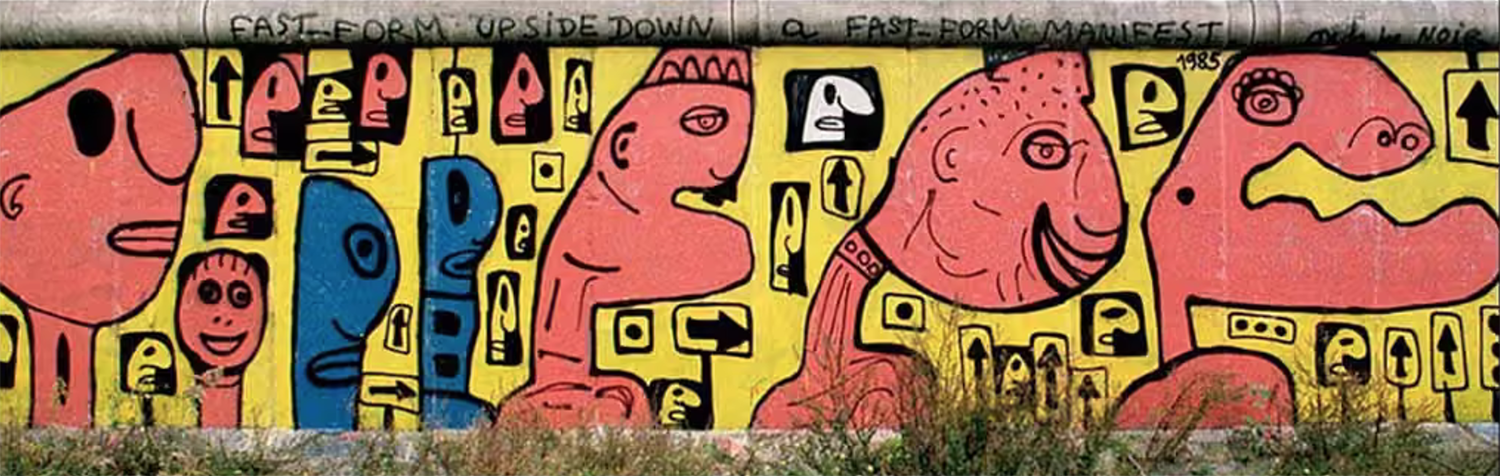
An example of some of Noir's earlier Berlin Wall art
“My early paintings on the Wall were very different to my later style. My style changed out of necessity, because every day hundreds of people would come up to me and ask me questions. So I had to adapt to be quicker, which became my Fast Form Manifesto. The Fast Form Manifesto is a good recipe for people who have to paint fast in dangerous environments, or with constantly interruptions. You need two ideas and three colours. It was a way for me to show people that this mythical wall was not built for ever and could be changed.” Thierry Noir
L-R Haring at work on the Wall, Noir & Haring deep in conversation, Noir & Bouchet's Statues of Liberty, Haring's mural (with Noir's statues clearly visible through the yellow)
It is well documented that in 1986 the celebrated American graffiti artist Keith Haring (1958-1990) painted a 300-metre section of the Wall near Checkpoint Charlie, one of the most dangerous crossing points of the Wall. What is rarely mentioned in the many articles about this famous event, was that in order for Haring to create his mural, a very large swathe of Thierry Noir's earlier paintings were obliterated by the yellow paint of Haring's.
In Noir's own words:
“It was the 100th anniversary of the Statue of Liberty, so I found some spray cans and with Christophe Bouchet made a two-metre-high stencil. It was made from a plastic napkin fixed on a wooden frame. On the Fourth of July, we put up 42 Statues of Liberty on the Wall at Checkpoint Charlie. It was well guarded and dangerous to paint there. We did not have enough money for more spray paint to do more the next day. As David Bowie said in his 1982 song Heroes: 'You can be heroes, just for one day.'
On 23 October 1986, I heard on the radio that Keith Haring was in Berlin to paint the Wall at Checkpoint Charlie. I went there and saw that my Statues of Liberty had all been painted over with yellow paint. I talked to Keith and he was embarrassed and apologised. He said: 'In New York you can get killed for that'. He was invited over and the section of Wall had been pre-prepared for him. The yellow was very transparent so you could see my statues through it. I was angry, but it was not his fault. Keith was a great guy and a great artist."
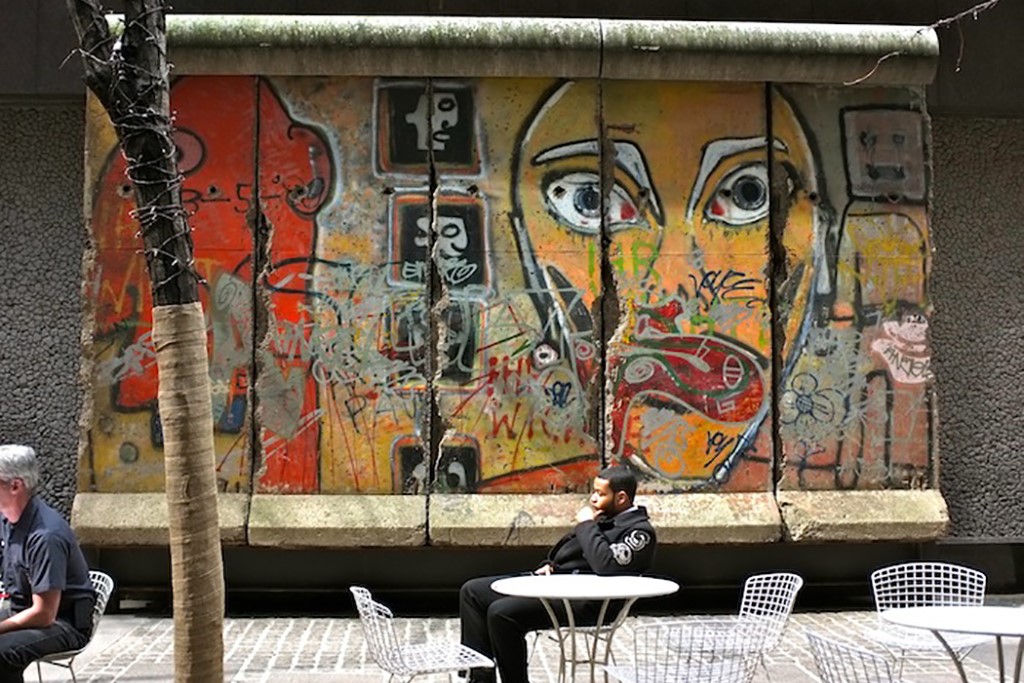
Also in October of 1986, the acclaimed director Wim Wenders started shooting his iconic romantic fantasy Wings of Desire in West Berlin. In a famous scene where the film switches into colour from black and white, and the protagonist Bruno Ganz, an Angel, sees colour for the first time, he walks past the Wall, covered in colourful grafitti whilst Thierry can be seen on a ladder painting in the background. You can view that scene here. After the Wall came down in 1989, multiple sections were auctioned by Sotheby’s at a 1990 sale in Monaco, including the famous stretch of Berlin Wall that Thierry was working on in this scene in Wings of Desire. These pieces of the Wall are now in a private courtyard at 520 Madison Avenue in New York. (above)
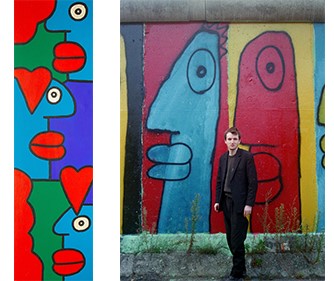
Lot 699 in the February sale, alongside an image of Thierry taken in 1986 standing in front of some of his iconic imagery painted on the Wall.
The painting by Thierry in our February sale was purchased from the artist by Heidi Stephenson who worked for ARTV in London between 1998 to 2001, making a programme for CNN called 'The Art Club', which each week was in a different city, meeting artists and exploring the art scene. In 2000, an episode was filmed in Berlin, for which Heidi was associate producer. The key interview was with Thierry, as he was a risk-taking artist well-known for having painted large sections of the Berlin Wall itself.
The style of the painting is iconic Thierry Noir, his trademark imagery honed during his years painting the Wall by the need for speed and symplicity married with the desire to create vibrant, life affirming imagery upon this stark symbol of division. His work has made him a pioneer of modern street art although in 1984 his aim was simply to "paint the Wall, to transform it, to make it ridiculous, and to help destroy it".
Years on from the fall of the Berlin Wall the historical significance of Noir’s ‘one real revolutionary’ act to paint the Wall has been evaluated by scholars and institutions around the World. Many institutions have commissioned Noir to paint Berlin Wall sections as a testament to the current freedoms we enjoy in the world today.
We leave the last words to Thierry:
"In the 1980s we had painted the wall to destroy it, now we do it to preserve a piece of it. As a memorial to remind future generations that this must never happen again."
Cornish Art, Fine Art and Studio Pottery
19th & 20th February
Viewing dates:
Saturday 14th February, 9am to 1pm,
Monday 16th, Tuesday 17th, and Wednesday 18th February 2026, 9am to 5pm