Lot 831
"The Brackenbury trio were so whole-hearted and helpful during all the early strenuous years of the militant suffrage movement.
We remember them with honour."
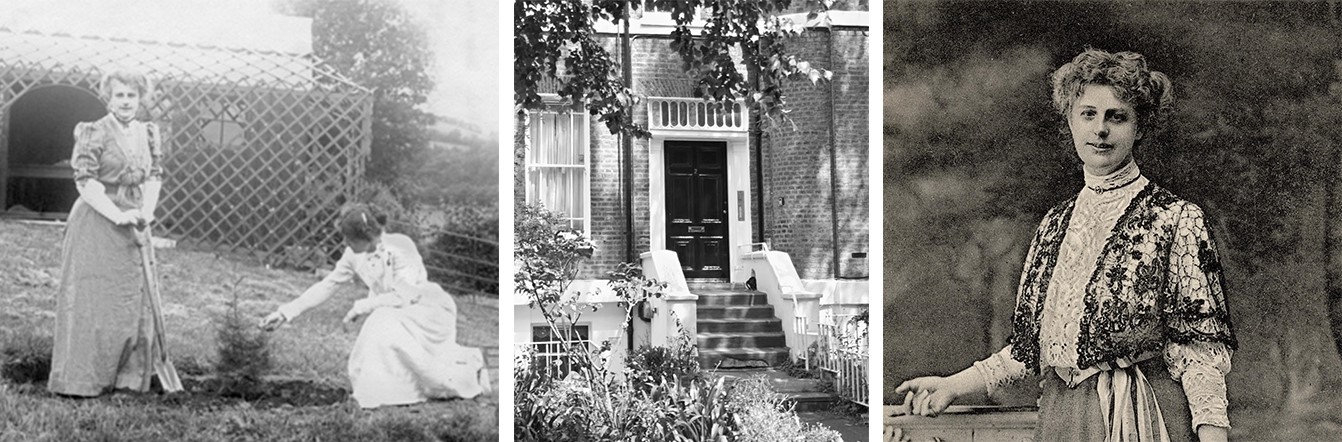
So reads a plaque made for 2 Campden Hill Square in London, the home of the Brackenbury family, the house was also known as Mouse Castle, an important location in the history of the women’s suffrage movement and most likely the place where this delightful portrait in our January Antiques sale was originally posed for and created.
Mouse Castle, in what is now fashionable Holland Park, West London, was a sanctuary where members of the
WSPU (The Women’s Social and Political Union) went to recuperate after being released from prison during the period of the despised Cat and Mouse Act of 1913.
L-R Georgina and her sister Marie, No.2 Campden Hill Sq, Georgina Brackenbury
But to understand this further we have to take a deeper look at the Brackenbury family themselves; mother Hilda and her artist daughters Marie and Georgina Brackenbury.
Hilda Eliza Brackenbury was born in Quebec in 1832, she married the decorated British major general and military correspondent Charles Booth Brackenbury in 1854 and they had six sons and three daughters. However, by 1891 Hilda had suffered the loss of three of her sons, her eldest daughter and her husband. Her remaining daughters Georgina and Marie were both artists, Georgina studied at the Slade School of Art from 1888, where she specialised in portraits, as suggested by the artist and tutor Hubert von Herkomer. Her sister Marie soon followed in her footsteps.
Hilda became interested in women's rights after the death of her husband, and in 1907 she joined the radical Women’s Social and Political Union (WSPU) which had been founded by the prominent social activist Emmeline Pankhurst in 1903. Hilda's daughters Georgina and Marie soon also joined the WSPU. Georgina was a gifted and inspiring public speaker and the two sisters transformed their studios in Holland Park into classrooms where they could train women in public speaking.
The Brackenburys became increasingly militant in their political activities.
They came from line of celebrated military men and they saw themselves as foot soldiers in the fight for women’s suffrage.
Georgina and Marie were sentenced to six weeks in prison after they joined a WSPU stunt at the House of Commons House of Commons. This was the "pantechnicon raid" in February 1908 when a furniture van was used as a "Trojan Horse" to get twenty suffragettes to the House of Commons. When they were close both Maria and Georgina joined the many who tried to rush their way into the lobby. They met surprised police who manhandled women to the ground, more than once, as they rushed to approach the doors.
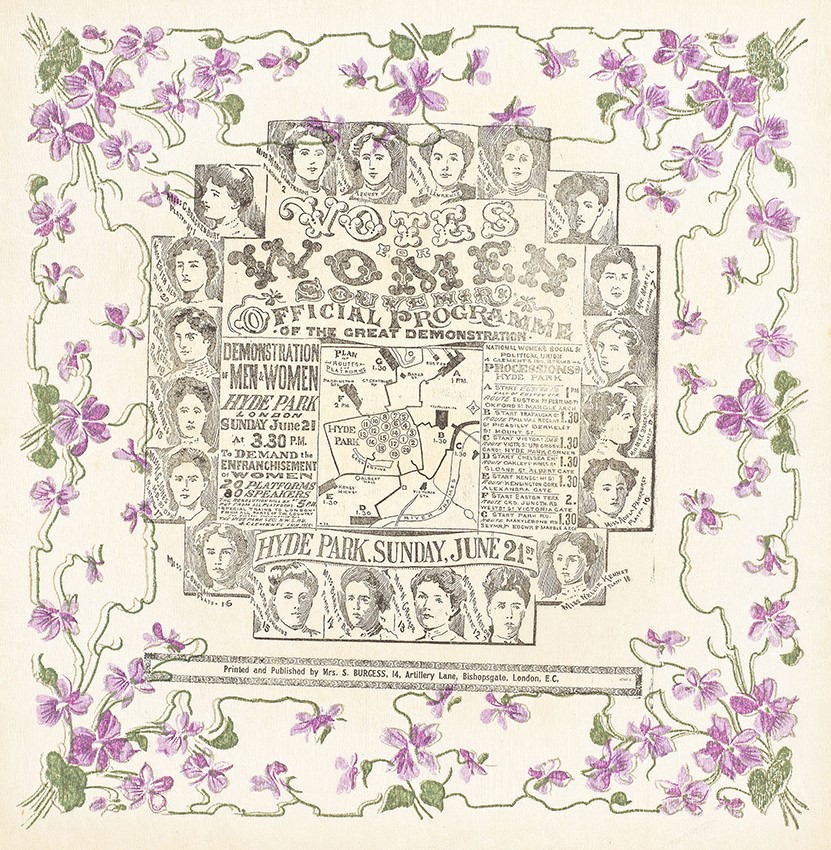
Souvenir and official programme of the Great Demonstration, Hyde Park, Sunday June 21 1908
In June of 1908, the WSPU organised a mass meeting called Women's Sunday at Hyde Park. The leadership intended it "would out-rival any of the great franchise demonstrations held by the men" in the 19th century. Sunday was chosen so that as many working women as possible could attend. It is claimed that it attracted a crowd of over 300,000. At the time, it was the largest protest to ever have taken place in Britain. Speakers included both Georgina and Marie Brackenbury, Emmeline Pankhurst, Christabel Pankhurst, Adela Pankhurst, Emmaline Pethick-Lawrence, Mary Gawthorpe, Jenny Bains, Annie Kenney and many other famous names from the Suffrage movement.
Women across the nation protested the 1911 census. “If women don’t count, neither shall they be counted”. Emmeline Pankhurst urged women to refuse to fill in the census or avoid the census altogether by making sure they were out of the house. The entry for the Brackenbury’s home, recorded by an official, that 25 women were present who would have been there avoiding the census in their own homes. Punch magazine joked: “The suffragettes have definitely taken leave of their census.”
By this time 2 Campden Hill Square was regularly offering sanctuary for women recovering from the cruel practice of force-feeding hunger strikers in prison. The Brackenbury’s home had become a hot bed of political activity and Hilda and her daughters were very much at the forefront of the WSPU’s activities.
In early 1912 Christabel Pankhurst decided that the WSPU needed to intensify its window breaking campaign and on the 1st of March bands of women marched through central London “smashing windows with stones and hammers." Hilda was arrested for breaking windows. Both her daughters were also arrested. In court Hilda made the point that two of her sons had been killed in India on active service whilst she had little political rights to vote. Hilda served eight days on remand and fourteen days in jail despite being 80 years old. She was asked to talk at the London Pavilion when she was released in April 1912.

In April 1913 the ‘Prisoners (Temporary Discharge for Ill-Health) Act’ commonly referred to as the Cat and Mouse Act was passed. Asquith’s liberal government saw that suffragettes hunger striking during their prison sentences were so dedicated to the cause that they would rather die than submit, and were alarmed by the prospect of them becoming suffragette martyrs, something they could not allow. Up until this point, many suffragettes had endured brutal force-feeding. The act allowed the authorities to discharge prisoners when their hunger strike made them dangerously ill. They would be released on licence in order to get well again but rearrested as soon as they were fit enough to recommence their sentence. It was a likened to a cat playing with a mouse before destroying it.
Hilda, Georgina and Marie Brackenbury turned their home at 2 Campden Hill Square into a convalescent home for recovering hunger strikers. It became known as ‘Mouse Castle’.
The famous suffragette
Annie Kenney experienced the Cat and Mouse Act for the first time in April 1912. She explained what happened in her autobiography, Memories of a Militant.
I had as my visitors the matron, the Governor, the doctor, the clergyman, and the visiting magistrate. They all asked me to eat and drink, but nothing would tempt me. The matron, the doctor and I became good friends. The doctor was ever so kind and did his best to persuade me to have fruit, but fruit was no use to me. "I must be out in three days, doctor, or I'll die on your hands!" And the good doctor did not want a death. In three days the gates were opened… Mrs. Brackenbury lent us her house at 2 Camden Hill Square. We called it 'Mouse Castle'. All the mice went there from prison and were nursed back to health and prepared for further danger work… When I recovered I was re-arrested.
Also in 1914, the Brackenbury home became the temporary WSPU headquarters after police raided its central office.
In 1918 after years of campaigning, women of property and over the age of 30 received the vote, and finally, universal suffrage was extended to all in July 1928.
Emmeline Pankhurst, painted by Georgina Brackenbury in 1927
Emmeline Pankhurst died in June of 1928, just days before the Representation of the People (equal franchise) Act was passed. Georgina Brackenbury with her sister Marie was one of her pallbearers, alongside eight other former senior suffragettes.
Georgina painted a portrait of Emmeline Pankhurst that was bought by her memorial committee for the nation, it now hangs in the National portrait Gallery's primary collection.
The work in our sale is dated 1907, so it was created during the early days of the Brackenbury’s political activism. We do not know the name of the sitter, it could have been a commission, she could be could be a fellow suffragette. The work comes from an estate where family members bear the name of Corbett, and there were prominent suffragettes of that name, it would certainly be an avenue of research worth following.
Regardless of who the kindly looking lady is in this charming portrait, she has caused great excitement here at Lay’s because she connects us so directly to such an important period of our history.
It is always worthwhile remembering the sacrifices many brave women made to obtain the right to vote.
Behind the soft pastel lines of this portrait, we know that the hand that created her was wielded by a woman of steely determination, who played a significant role in bringing about women’s suffrage.
So yes, we are just a little bit in awe!
Antique, Oak & Country and Interiors
15th & 16th January
Viewing dates:
Saturday 10th January 9am to 1pm
Monday 12th to Wednesday 14th January, 9am to 5pm