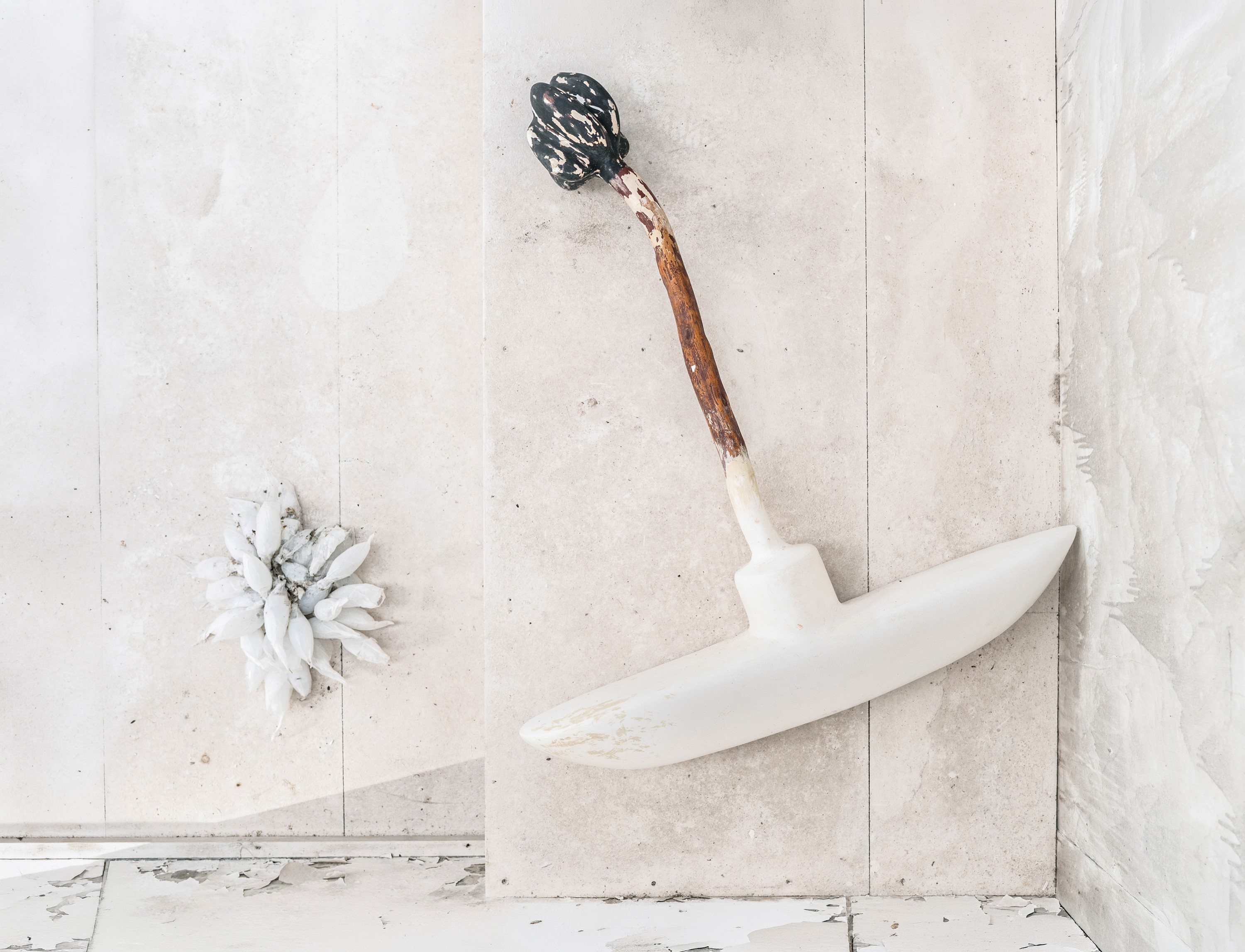
“I haven’t really been making work recently, I’ve more been rearranging things. My studio is an arena not a space for manufacturing objects. I do sometimes physically make an object but now so that it can be a part of a place. You can say that the work as such doesn’t exist, except in my mind in my eye.” - Harriet Bell
Trying to find the right words to describe the work of Harriet Bell is perplexing; they prove as elusive as a butterfly. Her work enigmatically resists verbal explanation and instead asks to be experienced and interpreted by the individual. Harriet is herself, in her very essence, the purest form of artistry. From my first meeting with her and throughout my journey of discovering her remarkable oeuvre and creative life, I have been deeply moved by the paradoxical nature of her work: it is quiet and still, yet profoundly powerful, it is transient, yet it leaves a lasting impact.
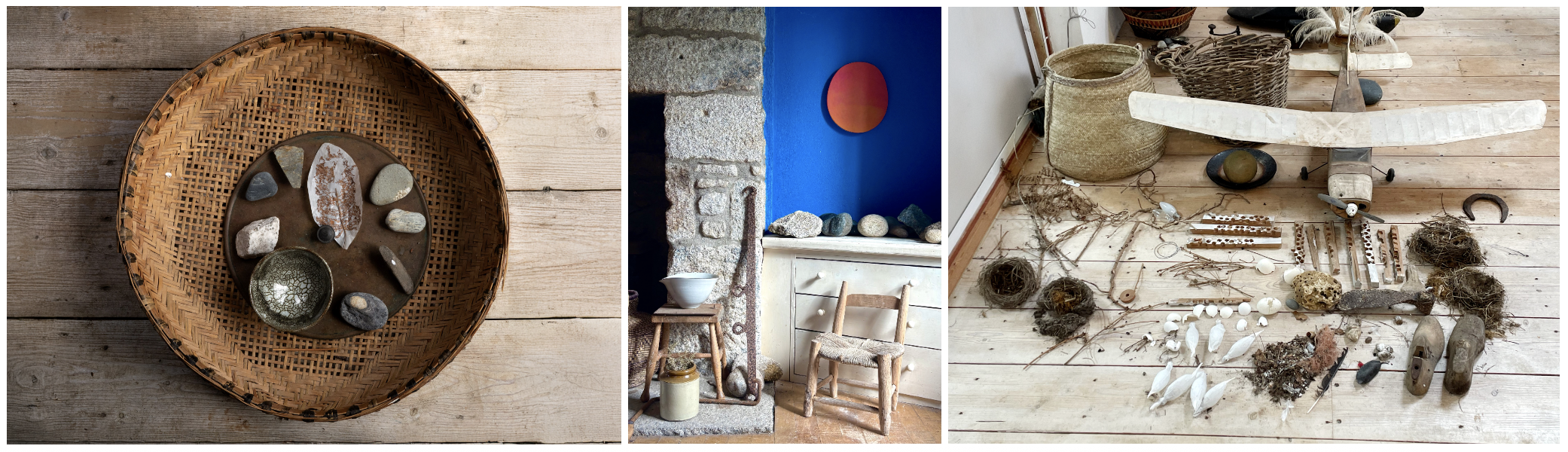
Harriet has left a lasting impact on me, as both an artist and an individual. Stepping out of a westerly gale into Harriet’s brightly decorated granite farmhouse, the atmosphere shifts to something serene and almost reverential. The dining table in front of me holds an exquisite display of carefully placed rocks, feathers, dried leaves, flowers and pottery bathed in a shaft of dancing dappled light that streams through the quietly rattling window. I am mesmerised.
As I am led through the kitchen and into the living room, the serenity continues. Meticulous groupings of found objects, books, Chinese ceramics, fauna, flora, light bulbs twisted in white tissue paper, a wooden airplane etc., occupy the space, not as clutter but as thoughtful compositions. As I stand there awestruck and slowly absorbing it all, Harriet looks at me, smiles and says, “I am an arranger” in an exaggerated French accent. The simplicity of the declaration feels entirely apt, and I am immediately drawn in.
The essence remains, but the arrangements themselves are fluid, moving and evolving until a quiet visual harmony is reached - a state that may endure for a day or a week before dispersing and re-emerging in new form. On each visit, I become more enamoured with Harriet’s world: not only the space and the artistry, but the emotion and philosophy it embodies.
Multi-disciplinary British artist, writer and poet Harriet Bell (née Corder) was born in Ankara, Turkey, in 1950, where her father, S. Pit Corder, a pioneering linguist whose work explored how meaning is constructed and understood through language, served as a cultural attaché for the British Council. Her peripatetic childhood, spent in countries including Jamaica and Colombia before returning to Britain, fostered an early familiarity with diverse environments and visual cultures.
In 1968-9, Bell studied at the Académie Charpentier in Paris, where she was introduced to a studio-based practice that emphasised direct observation and the material process of making. This approach resonates with the conceptual underpinnings of her artistic development, in which objects are carefully arranged and re-arranged to explore relationships of form, space and perception. After returning to Britain, she continued her training at the Birmingham College of Art and subsequently at Hornsey College of Art, where she met Trevor Bell.
Their shared artistic interests developed alongside their personal relationship, and in 1973, Harriet travelled to Tallahassee, Florida, to join Trevor following his appointment as a Visiting Professor at Florida State University. The couple married in Florida in 1975, where they would live and work for the next two decades.
During this period, they travelled extensively, visiting countries including Mexico, India, Thailand, Burma, Nepal and Taiwan, to name just a few. These explorations greatly influenced both artists, shaping their work not only materially but also conceptually and spiritually. Bell’s early works are three-dimensional assemblages in which she would arrange sculptural objects she had found or made from materials such as wood, string, and plaster on a table. A practice that she would continue to develop and incorporate symbiotically into the rhythms of her daily life.
By the mid-1970s, Bell began translating these intimate “table pieces” into mixed-media fabric pictures, which later evolved into large appliquéd wall hangings populated by fantastical characters drawn from the rich visual depths of her imagination.

(L-R) 226. St George’s, 1975. 222. Small Table, 1975. 225. Florida Room, 1975. 223. Dinner, 1975.
In 1980, Bell was a prize winner at the Jacksonville Museum of Art in Florida and received a Merit Award at the Halifax Art Festival. The following year, she held her first solo exhibition, The Companions, at the Four Arts Gallery in Tallahassee, an exhibition of monumental wall hangings measuring 5 by 7ft and stilted puppet theatre scenes inspired by characters from her own literary work.
Two of these hangings were subsequently acquired by the Florida House of Representatives. In 1982, Bell held her second solo exhibition, Dolls and Wall Hangings, at the Virginia Miller Gallery. The exhibition brought together a diverse body of work, including handmade dolls with painted faces, stuffed bodies and carefully crafted clothing, alongside hanging wall tapestries, papier mache objects and small painted wooden boxes. These boxes, rendered in bright, flat colours, contained whimsical, miniature worlds populated by figures and objects drawn from Bell’s vivid imagination. “I think my work always had something to do with magic. The early three-dimensional pieces, ‘table pieces’, were literally tables which I had laid with sculptural objects I had made from wood, string, plaster, tracing paper, and wire - objects which resembled nothing, had no purpose, but were present.
Later in Florida, I found such objects on the beach or in the woods - pieces of shells, rocks, roots, coral, palms - which I set on a table, and made my first fabric picture from. These were pictures of things in my daily life, fairly literal pictures about gardens, sitting rooms and picnics. Gradually the pictures became more abstracted, each element having no reference to any specific object, but being full of the same life as the original pieces. Finally they were recognisable entities which returned again and again to play a part - restless and strong, each element was like a ‘figure’, as in music, which had to relate and work rhythmically with every other figure, or to live inside the whole.” - Harriet Bell
In the mid 1980s, Bell was making large figurative painted wood and plaster sculptures, which had many affinities with folk art. The mythical figures were characters in an on-going narrative, both humorous and frightening. Richly painted, magical and mysterious. Her 1986 work, The Heresy, one of two pieces by Bell in the permanent collection of the Jacksonville Museum of Art, has been widely exhibited and stands as a commanding example of this period.
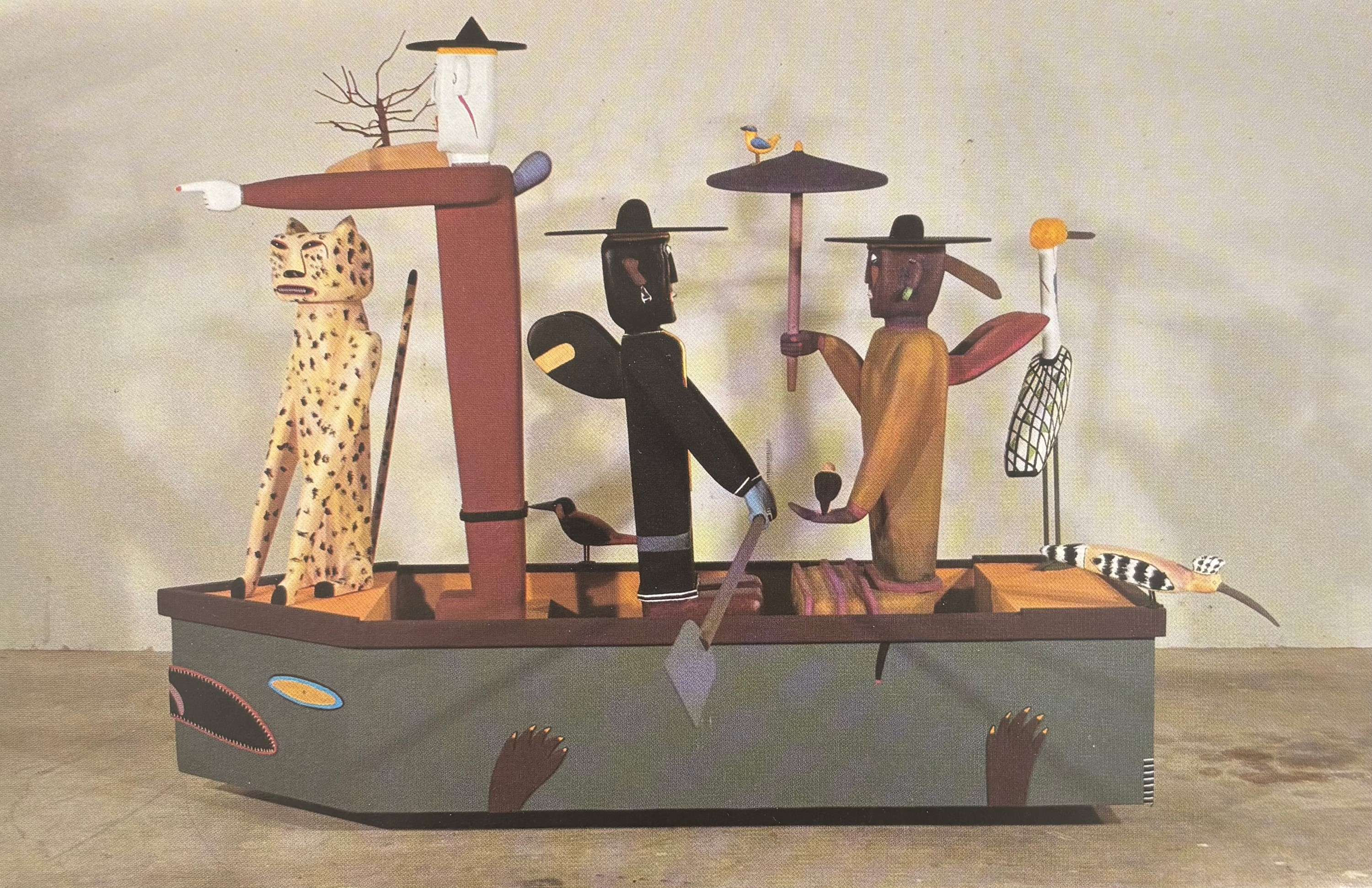
The Heresy, from the permanent collection of Jacksonville Museum of Art
Later, the work lost its figurative nature but always retained some element of the presence of natural beings. She continued to sculpt using wood, plaster, paint and gesso on both a large and more intimate scale. Many of the works from this period were exhibited in her 1992 solo show, Awkward Objects, held at the Florida Gallery, Centre for the Arts.
“These new pieces are about the closed states of growing things. They attempt to be complete and integrated onto themselves, with what is about to happen still sealed inside, or barely opening up. I’m looking for a quiet presence that sustains itself, suggesting an intense inner activity and an unarguable logic to each piece. I would like them to be of the essence.” - Harriet Bell
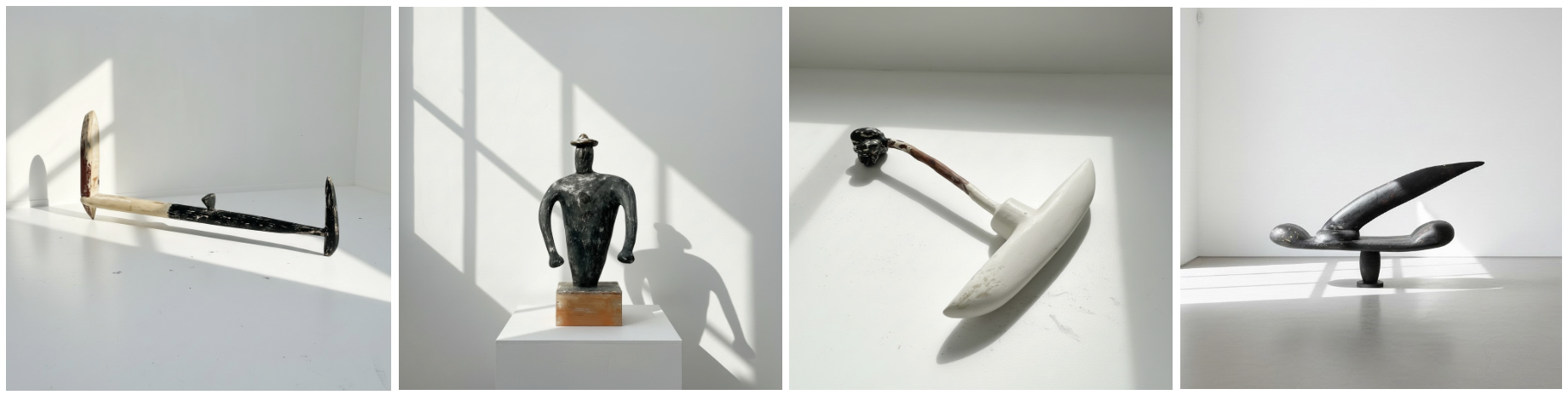 (L-R) 263. Jack’s Table, 1988. 274.Homme, 1991. 260. Twist, 1988. 256. Bengal, 1989
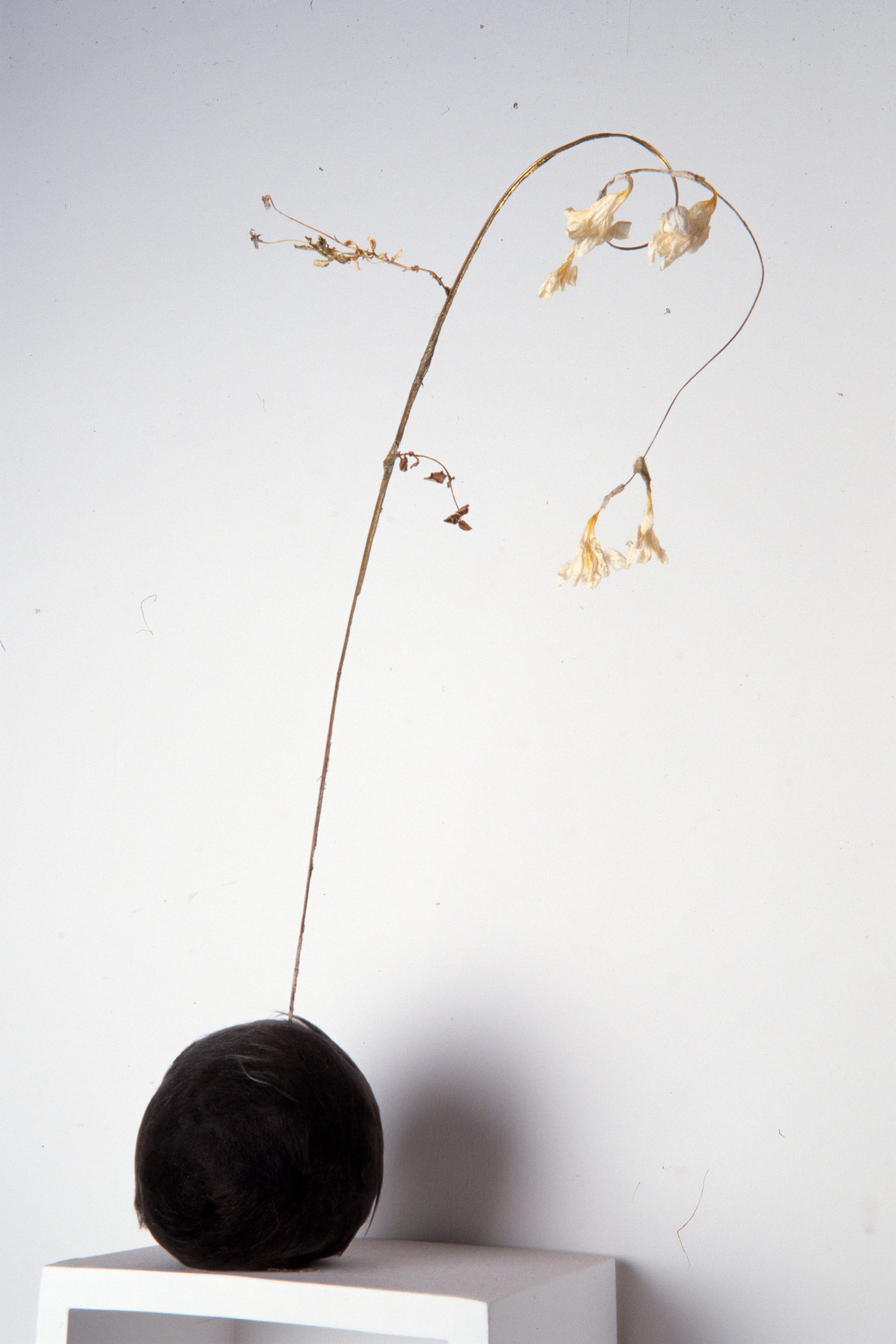
In 1996, Trevor and Harriet Bell returned to the UK and settled in West Cornwall. Here, Harriet’s work continued to evolve, moving away from fixed form towards something more transient and ephemeral. She increasingly worked with materials found around her - gathered from fields, hedgerows, shorelines and clifftops - while also drawing inspiration from the overlooked and discarded: a sliver of glass, burnt foil, light bulbs, fragments of gauze.
These humble elements became the building blocks of an alchemistic venture into an existential exploration of transformation and the cycles of life. “I haven’t really been making work recently, I’ve more been rearranging things. My studio is an arena not a space for manufacturing objects. I do sometimes physically make an object but now so that it can be a part of a place. You can say that the work as such doesn’t exist, except in my mind in my eye.” - Harriet Bell
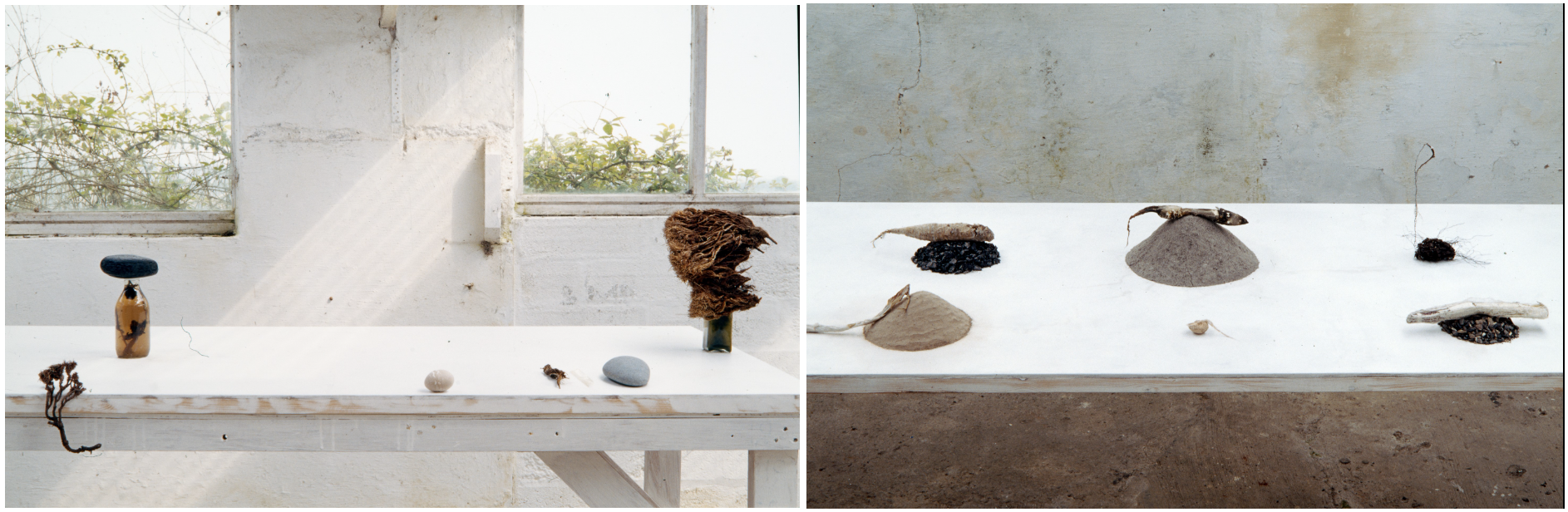
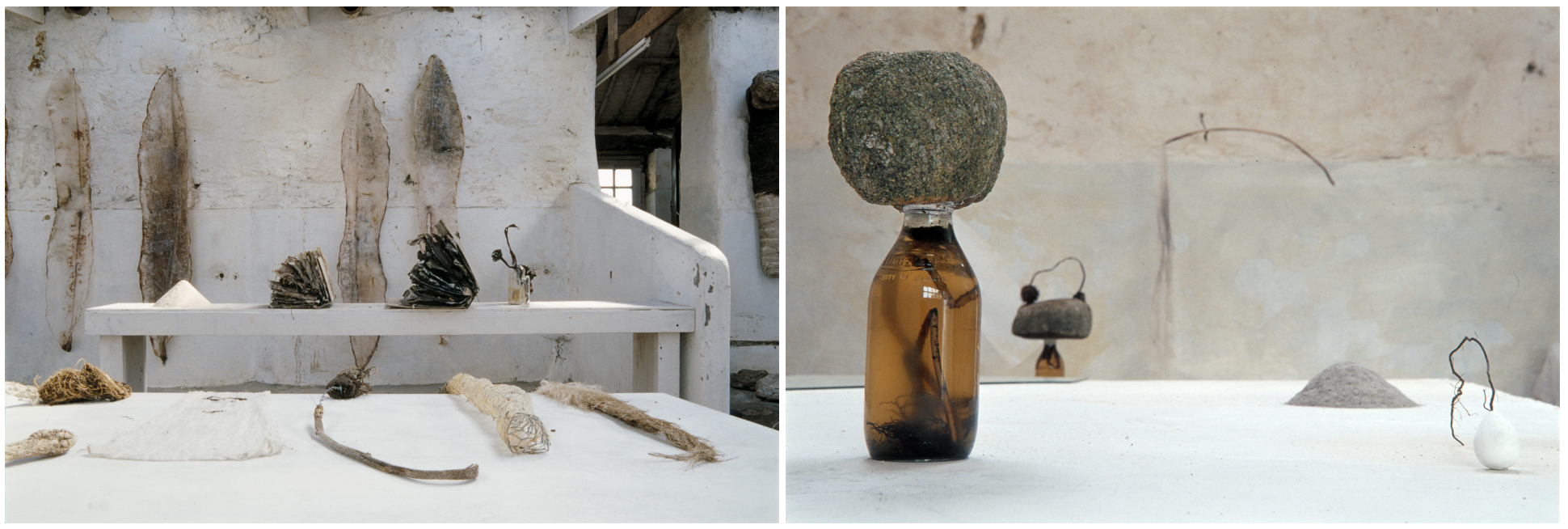 Photos by Steve Tanner
Literature, language and philosophy have been a fundamental underpinning of Harriet Bell’s work and life. From the mythological characters and stories that animated her early figurative sculptures, wall hangings, theatrical constructions and collages, narrative played a central role in her practice. As her work developed, explicit storytelling gradually receded, yet books and language remained ever-present and increasingly became material elements within the work itself. Words and sentences were cut out and collaged, illustrations altered, and entire publications transformed through the application of earth, ashes and fragments of flora and fauna.
Just as her father’s linguistic research examined how errors and interpretation reveal deeper structures of understanding, Bell’s art reflects a similarly reflective engagement with the world: meaning emerges through observation and the subtle dialogue between elements.
Somewhat reclusive by nature, Harriet became happily sequestered within the wild landscape of West Penwith. Despite this, she continued to exhibit her work - if sometimes a little reluctantly - including two solo exhibitions at the New Millennium Gallery (now Anima-Mundi), St Ives, a solo exhibition at Newlyn Art Gallery, a touring exhibition in Slovenia, and the inclusion of selected works in two exhibitions at Tate St Ives, among others.
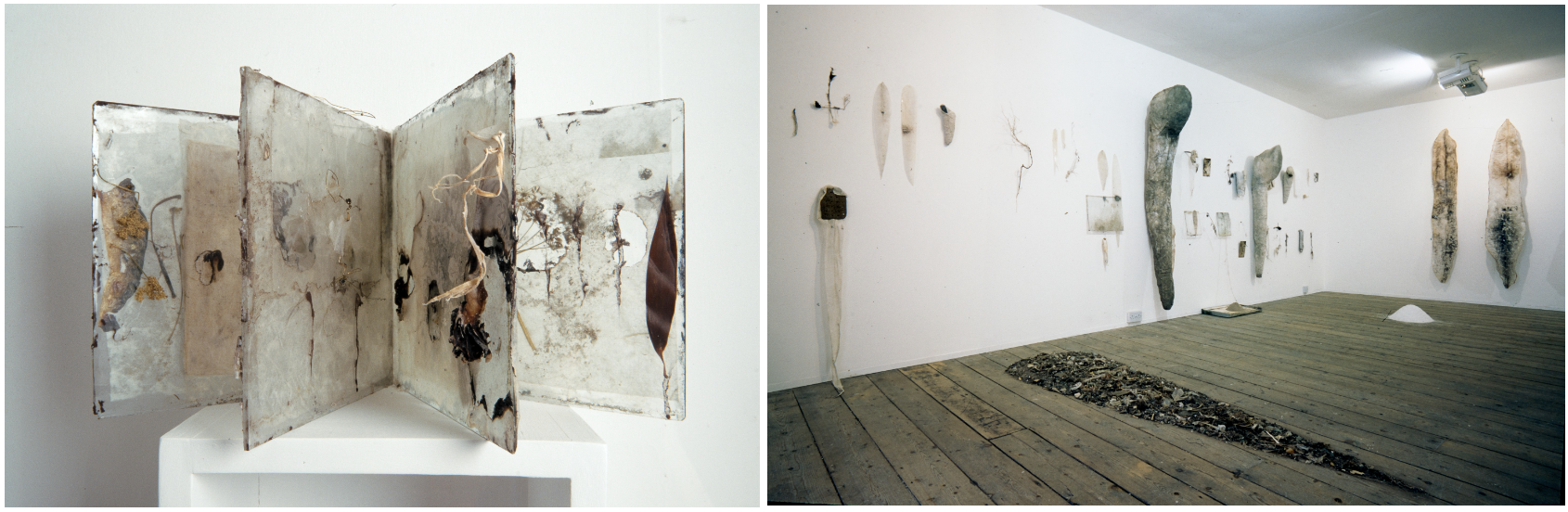
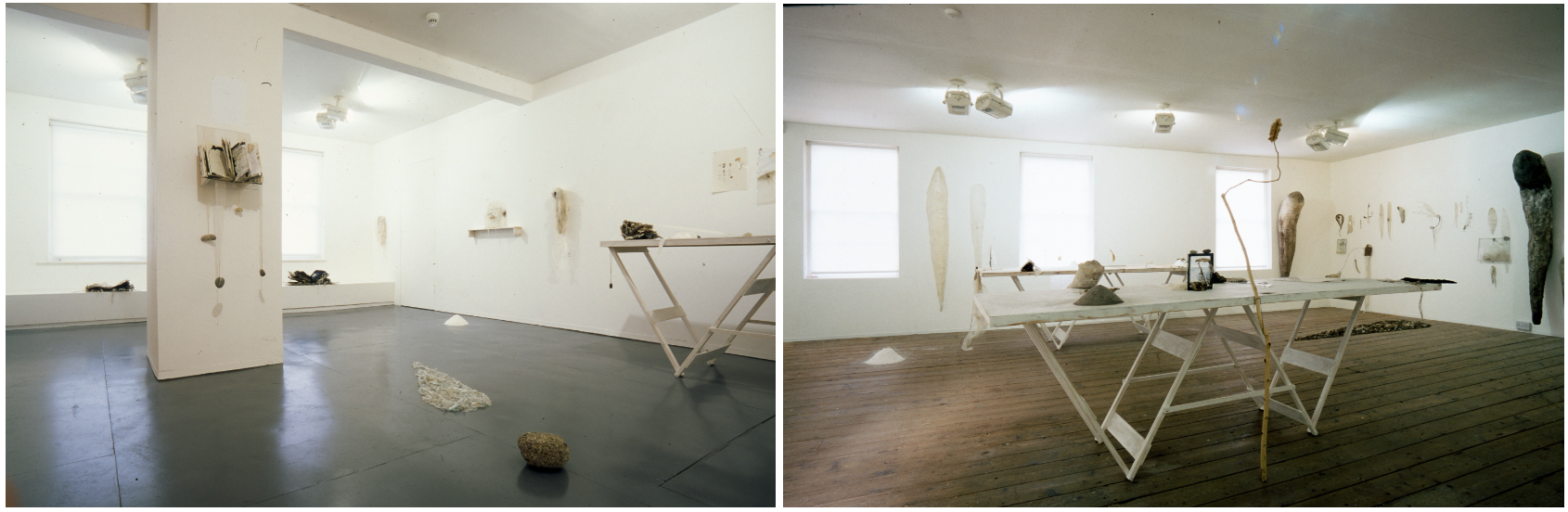
Harriet Bell exhibition at Anima Mundi
Harriet Bell’s sculptures, from monumental figurative works to more intimate pieces in wood, plaster and paint, remain the enduring heart of her practice. Her later assemblages and installations, ephemeral and experienced only in the moment, cannot be collected, yet their spirit is echoed in every sculpture. Her practice has always existed most fully within the quiet intimacy of her own environment, where objects, materials and ideas are arranged, rearranged, and brought into fleeting yet meaningful relationships. In her work, observation, imagination, and play converge; leaving a lasting impression that extends far beyond the gallery walls.
View Harriet's exceptional work here.
Trevor and Harriet Bell
16th April, 2026 | Penzance & live online
The news, history and stories behind our art and antiques